DEPARTMENT OF CIVIL

About Department

The Department of Civil engineering is established in 2013.The Civil Engineering Department administers a Civil Engineering program that will produce graduates who are ready to work,high in quality,skilled in information technology and are professional in nature. The department also strives to undertake a program in community service and to disseminate advanced technical knowledge to engineers, other professionals and the public. The department of Civil Engineering ensures that the Students have the opportunity to work with latest equipment both in the laboratories and while on project with various construction companies in and around the city. Universal Testing machines, UV Spectrophotometer, 200 T Compressive Testing Machine, Constant heat B.O.D. Incubators are few instruments that they regularly use during their sessionals. Fields in which the faculty is specialized are Structural Engineering, Geo-Technical Engineering,Hydrology, Water Resources, Foundation Engineering, Construction Management, Entrepreneurship etc. To become a study Program that is accepted as a model in the field of civil engineering education and leads to the application of civil engineering to provide quality professional and community services.
Vision & Mission

Vision

: To become a school of excellence that brings out civil engineers with high technical competencies and promotes high-end research to meet the current and future challenges in civil engineering.

Mission

• To offer Under-Graduate programmes in civil engineering and other skill development courses that add value to student competencies. • To promote quality education, research and consultancy for industrial and societal needs. • To inculcate moral and ethical values among the students. • To impart knowledge with emphasis on the development of leadership qualities in students. • To provide state-of-the-art resources that contributes to a congenial learning environment. • To encourage students to pursue higher education and take competitive exams and various career enhancing courses. • To establish centers of excellence in emerging areas of research. • To have regular interaction with industry and offer solutions to their problems.

PO's, PEO's, PSO's

Programme Outcomes

  1. PO1. Engineering Knowledge: Apply the knowledge of mathematics, science, engineering fundamentals, and an engineering specialization to the solution of complex engineering problems
  2. PO2. Problem analysis: Identify, formulate, review research literature, and analyze complex engineering problems reaching substantiated conclusions using first principles of mathematics, natural sciences, and engineering sciences. .
  3. PO3. Design / development of solutions: Design solutions for complex engineering problems and design system components or processes that meet the specified needs with appropriate consideration for the public health and safety, and the cultural, societal, and environmental considerations.
  4. PO4. Conduct investigations of complex problems: Use research-based knowledge and research methods including design of experiments, analysis and interpretation of data, and synthesis of the information to provide valid conclusions.
  5. PO5. Modern tool usage: Create, select, and apply appropriate techniques, resources, and modern engineering and IT tools including prediction and modeling to complex engineering activities with an understanding of the limitations.
  6. PO6. The engineer and society: Apply reasoning informed by the contextual knowledge to assess health, safety, legal and cultural issues and the consequent responsibilities relevant to the engineering practice.
  7. PO7. Environment and sustainability: Understand the impact of the professional engineering solutions In societal and environmental contexts, and demonstrate the knowledge of and need for sustainable development.
  8. PO8. Ethics: Apply ethical principles and commit to professional ethics and responsibilities and norms of the engineering practice.
  9. PO9. Individual and team work: Function effectively as an individual, and as a member or leader in diverse teams, and in multidisciplinary settings.
  10. PO10. Communication: Communicate effectivelyon complex engineering activities with the engineering community and with society at large, such as, being able to comprehend and write effective reports and design documentation, make effective presentations, and give and receive clear instructions.
  11. PO11. Project management and finance: Demonstrate knowledge and understanding of the engineering and management principles and apply these to one's own work, as a member and leader in a team, to manage projects' and in multidisciplinary environments.
  12. PO12. Life-long learning:  Recognize the need for, and have the preparation and ability to engage in independent and life-long learning in the broadest context of technological change.

Programme Educational Objectives

  1. PEO1. To impart quality education and knowledge in contemporary science and technology to meet the challenges in the field of Civil Engineering and to serve the society.
  2. PEO2. To impart the knowledge of analysis and design using the codes of practice and software packages.
  3. PEO3. To inculcate the sense of ethics, morality, creativity, leadership, professionalism, self confidence and independent thinking.
  4. PEO4. To motivate the students to take up higher studies and innovative research projects.

Programme Spicific Outcomes

  1. PSO1. The student has the ability to apply the knowledge of Physics, Chemistry, Mathematics, Programming Skills and Soft Skills to solve Civil Engineering problems.
  2. PSO2. The student has the proficiency in streams of Civil Engineering to visualise and execute the systems for sustainable living.
  3. PSO3. The student has the practical knowledge and experimental skills to tackle Civil Engineering problems using technical and management skills, exhibiting professional ethics to meet the societal needs.
  4. PSO4. The programme enables the faculty to develop academic proficiency by involving in research & innovation, interaction with industry and professional bodies through technical advice and Continuing Education Programs (CEP) to meet the needs of the user system.

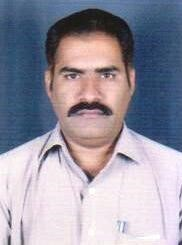
HOD Profile

Name :

Dr. Rayasam. Venkata Siva Raghava Sarma

Designation :

Associate Professor & H.O.D

Total Experience :

25 Years

Teaching Experience :

8.5 Years

Handled Subjects

Strength of Materials, Geo Technical Engineering, Building Planning & Drawing, Water Resources Engineering Estimation Specifications and Contracts, Engineering geology.

Industrial Experience

16 Years of Industrial experience in various positions in Civil and Structural works like Tunnel, Powerplant construction, Building Construction, Canal works, watershed works, Pipeline works and procurement activities etc. and worked with government departments and corporate firms.

Education

  • Ph.D – (Geo Technical Engineering) Mewar University, Chittorgarh, Rajasthan 201990
  • M.Tech in Civil Engineering (Geotechnical Engineering Specialisation), Jawaharlal Nehru Technological University, Hyderabad, India,
  • B.Tech(Civil Engineering) Jawaharlal Nehru Technological University, Hyderabad, India.

Membership / Certification

  • Charted Engineer, Civil Engineering – Indian Institute of Engineers, Kolkata
  • Associate member of Indian Institute of Engineers, Kolkata.
  • Corporate membership of the Indian Institute of Valuers.

Research / Selected Publications

1.National
  • R.V.S.Raghava Sarma, Dr. D.S.V.Prasad "Utilization Of Waste Plastics In Flexible Pavements" in Journal Of Engineering Sciences JES, Volume 10, Issue 10 , October -2019.
2. International
  • R.V.S.Raghava Sarma, Dr. D.S.V.Prasad "Utilization Of Waste Plastics In Flexible Pavements" in Journal Of Engineering Sciences JES, Volume 10, Issue 10 , October -2019.
  • R.V.S.Raghava Sarma, Dr. D.S.V.Prasad "Sub grade stabilization by using flyash reinforced with bitumen coated Bamboo mesh" Journal of Emerging Technologies and Innovative Research October 2019, JETIR, Volume 6, Issue 6, IS 2349 – 5162.
  • R.V.S.Raghava Sarma, Dr. Nirmal Kumar " Analytical study on the pavement construction with the utilization of industrial wastes" International journal of early childhood special education (INT-JECSE), Volume 6, Issue 02,2022, ISSN 1308-5581.
3. Books
  • Title of the book : Basic Civil And Mechanical Engineering published in Scientific International Publishing House . Website : www.sipinternationalpublishers.com ISBN: 978-93-5757-722-9

Additional Responsibility

RESPONSIBILITIES WITHIN THE INSTITUTE
  • Chairman, BOS, Department of Civil Engineering

Facilities/Laboratories

Environmental Engineering Laboratory

Environment Engineering is one of the important branch of Civil Engineering that deals with the process of converting the waste water of industries and domestic into usable water. It includes various process of determining the impurities and their level by undergoing various tests and by knowing the amount of impurities, various processes could be done to make that water usable. List of equipments:
• COD Digestion Apparatus
• BOD Digestion Apparatus
• Vertical Autoclave
• Bacteriological incubator
• Desiccators glass
• Muffle Furness
• Hot air oven
• PH meter
• Floculator
• Glass thermometer
• Conductivity meter
• Hot plate.

Transportation Engineering Laboratory

Highway engineering is deals with the planning, design, construction, operation, and maintenance of roads, bridges, and tunnels to ensure safe and effective transportation of people and goods with the strength, rigidity, flexibility, lucidity, smoothness, shock-absorbance, bonding strength of the mix, load bearing capacity of the roads and many others qualities of the highway are due the bitumen and aggregate which are spread with it's well-calculated materials through out the pavement.List of equipments:
• Los Angeles Abrasion Test
• Penetration Test
• Softening point test
• Deval Abrasion Test
• Flakiness Index
• Elongation Index Test
• Marshal Stability Test
• Ring and ball apparatus
• Ductility Test
• Aggregate Impact Test.

Strength of Material Laboratory

In materials science, the strength of a material is its ability to withstand an applied load without failure. The field of strength of materials deals with forces and deformations that result from their acting on a material. Strength of material is a subject which deals with the behavior of solid objects subject to stresses and strains. Basic Fundamentals of All the basic practices of Strength of materials are performed in this laboratory. In this laboratory various sophisticated Apparatus available in lab are as follows:List of Equipment
• Universal Testing Machine
• Torsion Testing Machine
• Brinell Hardness Testing Machine
• Single Purchase Machine
• Polygon of Force Apparatus
• System of Pulleys
• Wheel & Differential Axle
• Co-Planner concurrent & Non Co-Planner concurrent of Force
• Beam Lever Apparatus.

Auto Cad Lab

Civil Engineering Computer lab is the use of computer systems to assist in the creation, modification, analysis, or optimization of residential, commercial & industrial structure planning and layout. Civil Engineering software is used to increase the productivity of the designer, improve the quality of design, improve communications through documentation, and to create a database for manufacturing or Detail study about the building drawing and survey work like designing Highway, Canal And structure.
Software facilities available:
• Auto cad
• MS Office

Concrete Technology Laboratory

The 'concrete' is the strength in imagination. The primary activities include experimental studies on different types of materials which are using in construction and testing of concrete specimens in various exposure conditions. The Concrete technology Laboratory also offers technical services for testing and research on the structural behavior and properties of materials. The concrete laboratory is equipped with all the equipment's required for manufacturing and testing of specimens. For Civil Engineer 'Concrete' is one of the important construction materials. Study of its constituents and their properties is essential for preparing and to develop required field knowledge.
Our Laboratory equipped with
• Compression testing machine
• Universal testing machine
• Vicat Apparatus
• Impact Testing machine
• Slump mould
• compacting factor apparatus
• aggregate impact equipment
• sieve shaker
• vibrating table, Cubes
• Cylindrical mould etc

Surveying Laboratory

Surveying is the technique, profession, and science of accurately determining the terrestrial or three-dimensional position of points and the distances and angles between them, commonly practiced by surveyors, and members of various engineering professions. These points are usually on the surface of the Earth, and they are often used to establish land maps and boundaries for ownership, locations like building corners or the surface location of subsurface features, or other purposes required by government or civil law, such as property sales. Surveying is one of the basic area in civil engineering which includes linear and angular measurements of relative positions of the points on the surface of the earth. Students learn techniques for gathering field data with both traditional and modern instruments and demonstrate their proficiency on weekly lab exercises and a comprehensive semester project and final exam. List of equipments
• Theodolite
• Dumpy level
• Planimeter
• Leveling staff
• Prismatic compass
• Metallic Tape
• Plane table with tripod
• Trough compass
• Chain

Geotechnical Engineering Laboratory

Research and teaching in the field of geology and mineral resources engineering involves the use of processing and analysis of materials with widely varying properties. The laboratory is equipped to perform all the necessary basic characterization of soils. Geotechnical engineering is the branch of civil engineering that deals with the engineering behavior of subsurface materials. It includes Soil Mechanics, which is essential to identify, characterize and study the mechanics of soil/rock and Applied Soil Mechanics, which transfers the behavioral knowledge to practice. List of Laboratory Equipment's Available:
• Sieve Sets And Shakers
• Direst Shear Test Equipment
• Tri axial Test Equipment
• Unconfined Compression Test Equipment
• Consolidation Test Equipment
• Vane Shear Test Equipment
• Standard Penetration Test
• Field Density Apparatus
• CBR Testing Machines
• Specific Gravity By Pycnometer

Engineering geology Laboratory

Engineering geology is the application of the geological sciences to engineering study for the purpose of assuring that the geological factors regarding the location, design, construction, operation and maintenance of engineering works are recognized and accounted for. Engineering provide geological and geotechnical recommendations, analysis, and design associated with human development and various types of structures. The realm of the engineering geologist is essentially in the area of earth-structure interactions, or investigation of how the earth or earth processes impact human made structures and human activities. The practice of engineering geology is also very closely related to the practice of geological engineering. If there is a difference in the content of the disciplines, it mainly lies in the training or experience of the practitioner.List of Laboratory Equipment's Available:
• Mineral Specimens
• Rock Specimens
• Geological maps
• Steak Plates
• Earth Layer Model
• Pen Knives
• Structural Geology Wooden Models(Folds)
• Structural Geology Wooden Models(Faults)
• Brunton Compass
• Magnifying Lenses

The department has number of well equipped laboratories and provides excellent facilities for learning.

Some of the Highlights of the department Labs:

The Department has the following sophisticated laboratories.All the equipments in the laboratories are sophisticated and as per IS standards with well spacious area the students can learn by conducting the experiments. Laboratories have beyond the syllabus experiments which can be useful for practical knowledge.

Laboratories at UG Level:

1. Concrete and highway Materials Lab
2. Geo Technical Engineering Lab
3. Surveying Lab - I & II
4. Strength of Material Lab
5. Fluid Mechanics and Hydraulic machinery Lab
6. Engineering Geology lab
7. Auto-CAD Lab
8. Environmental Engineering Lab
9.Transportation Engineering lab
10.Gis and Staad pro lab

Events

Workshops / Seminars / Guest Lectures


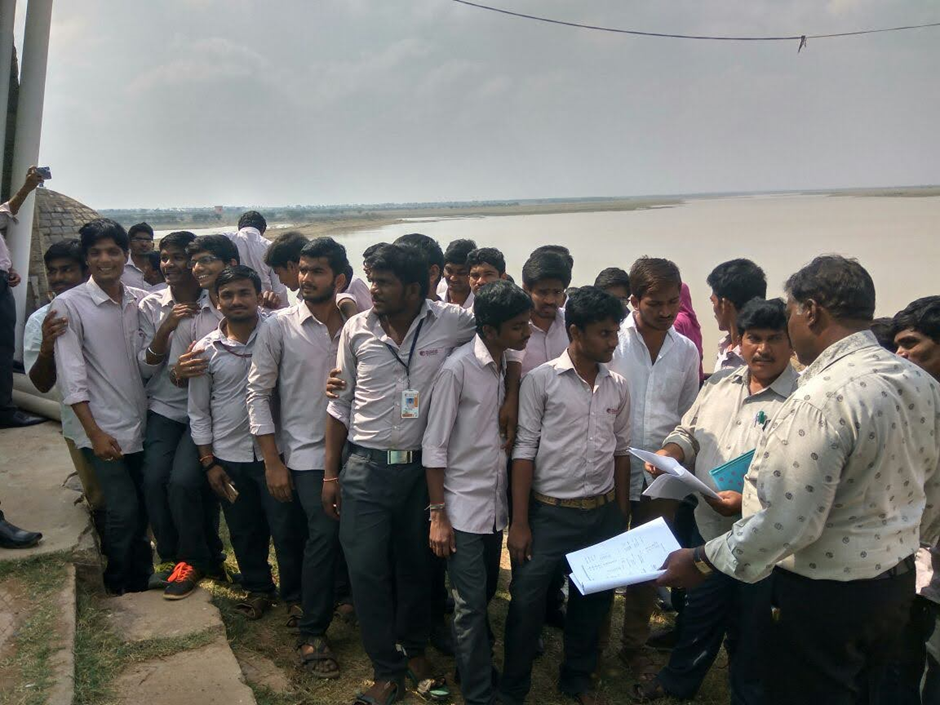
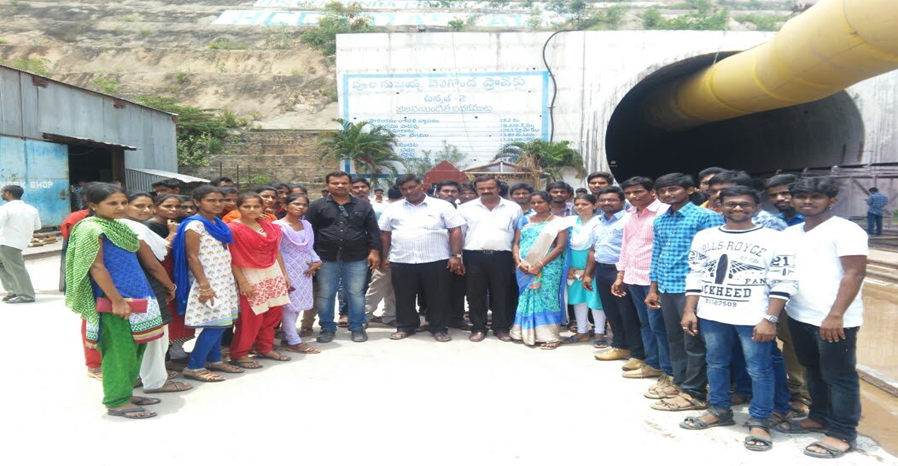
Industrial Visits/ Field Trips


Mallavaram Dam visited on Dt:10-08-2019


Pula Subbaiah Veligonda Project Site visited on Dt:09-08-2018


WORKSHOPS


Achievements

1. Faculty Achievements:


2. Journal Publications:


3. Memberships:

Toppers

BATCH: 2020-24


BATCH: 2019 - 23


BATCH: 2018 - 22


BATCH: 2017 - 21


BATCH: 2016 - 20


BATCH: 2015 - 19


BATCH: 2014 - 18


BATCH: 2013-17

Internships

Internships link

Faculty